Wood burning for heat — and all that implies — was just part of life on the farm when I was young. Dad built his own woodshed on a frame of large ash posts, with whatever lumber he had available for the walls and a corrugated metal roof for protection from the elements. We cut wood in the winter and spring months for the next year’s heating season. My sisters helped with stacking and hauling it in to the house each weekend.
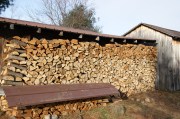
Our expenses consisted of gas, oil, chain sharpening and an occasional part for his old Homelite 330. The wood was free — mainly cherry, maple, beech and oak — culled from the large stands of hardwood forest behind our house and scattered around the farm. The labor rate couldn’t be beat. I remember Dad’s response to my one and only request for an allowance: “You already get free room and board. You should be paying me.”For all the complaining I probably did back then, I really didn’t mind the work. It got me outside. It made me feel like a man. It was cool.
Back then, I never had to stress or strategize over the process or its implications for our family. I was just there to work.
Fast forward 22 years or so.
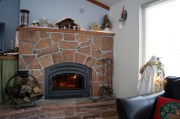
In January of this year, after a couple decades free from any concerns over firewood procurement, I moved my family to the North Country — the region encompassing upstate New York’s northern Adirondacks and the St. Lawrence Seaway. As we would soon learn, it gets damn cold here. And heating a home is an expensive proposition. We also learned that natural gas is not readily available in this region as it is everywhere else in the free world. Folks here heat primarily with heating oil or firewood. Our home relies on the former as its primary source of heat for the home and hot water. A high-efficiency fireplace on the upper level augments the oil-burning furnace and helps heat that floor.
The fireplace was a novelty for us for the first month. It was fun to build a fire in the evening and enjoy the warmth and glow with the kids and puppies. During that first month, the humming and rattling of the furnace running in the garage didn’t concern me.
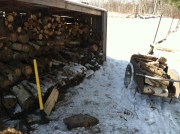
That sound would soon become the bane of my existence.
The owners had filled the oil tank just prior to our arrival. Our first oil delivery was required about five weeks later. It was for 150 gallons at a cost of nearly $600! And, as the locals kept reminding me, we were in the midst of one of the mildest winters on record.
Suddenly, the fireplace became a tool for survival.
And I began stressing and strategizing.
We live on 27 acres of mixed hardwoods and hemlock, and to my good fortune, the owner had the property cruised by a local forester from SUNY Canton a couple years ago. There were probably a hundred or more trees already marked for culling on the property.
I was set. Or so I thought.
A chain of events soon began that saw both of my old chainsaws out of service without having felled a single tree. They were followed by a Craigslist “find”that ended up being another misfit chainsaw with a bad clutch. I now owned three chainsaws, none of which worked or could be fixed economically.
It was summer, and I was getting nervous.
My father-in-law saved me during one of our visits back home to Pennsylvania by giving me an Echo 670 with an 18-inch bar. It worked flawlessly because it was his, and everything he owns works flawlessly. It
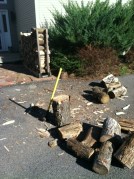
sliced through logs like a hot knife through butter. I started cutting wood at a fevered pitch. Within a week I had well over a cord of wood cut, split and stacked. Then it hit me. This wood wasn’t going to be seasoned sufficiently for at least six months, despite the fact that it was all from already dead birches and beeches on the fringe of our lawn.
I was going to need to buy firewood in order to be prepared. Turns out, I had a lot to learn about buying firewood.
The first lesson I learned is that a cord of wood in this part of the world is not the same as a cord of wood where I come from. A cord is, in fact, a stack of wood four feet high, four feet deep and eight feet long. A cord, as folks in the North Country call it, is actually a face cord — or roughly one-third of a cord. This is very important to know when you think you’re getting a screamin’ deal on what you estimate to be a month-worth of firewood for $65 and you’re really buying ten days-worth.
I also learned that there’s a difference between seasoned wood and
dry wood. Seasoned wood might have been cut six months ago, but can still have a moisture content around 50% or higher. This wood will hiss and sizzle in the fireplace, never really develop a high heat and contribute to faster creosote build-up in chimney pipes. Dry wood will be light in weight, typically greyed in color with evident cracks, or checks, across the bias of the endgrains. Seasoning and drying times vary among species, but a safe rule of thumb is that wood should be cut and split for a full year before truly being dry enough for proper home heating.
Twenty-odd years of repression had protected me from memories of dealing with Elm — the wood that fuels the fires of Hell. Elm is a ridiculously strong, sinewy and fibrous wood that’s nearly impossible to split. Even the smallest pieces will typically take at least a few strokes to split. I purchased a face cord of it from a friend and spent the better part of an afternoon splitting it. Weeks later, I still have the torn tendons in my elbows as a reminder of that and subsequent afternoons spent splitting, carrying and stacking hardwood.
Despite my struggles with firewood over these past months, I can still safely say there’s no more welcoming smell than the tendrils of woodsmoke that glide through the trees and greet me as I approach our house after a long day in the woods.
 The Good Medicine Camp