The following blog post, written by Randy, appeared originally on the Ernst Conservation Seeds website on March 15, 2017:
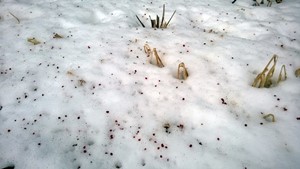
With the onset of all this March Madness, a window of opportunity is closing for landowners to get a jump on early planting of native seeds:
You’re running out of time for frost seeding.
And if you live below the Mason-Dixon Line or in the Southwest, the shot clock may have already expired.
Frost seeding is a means of broadcasting seed directly onto the snow or bare ground during the late winter and early spring months, in time for the freeze-thaw cycle that occurs from day-to-day at this time. The method takes a cue from nature’s playbook, mimicking the seed disbursing process of many native species during fall and winter months, and allowing natural processes to occur which thin and soften the seed coat and help prepare the seed for germination. The introduction of moisture, which freezes and thaws, as well as the friction of seeds rubbing against grains of sand, soil, gravel and each other, help to accomplish this seed coat preparation.
In addition to these processes, a key to successful germination is the establishment of good seed-to-soil contact. This is where frost seeding makes things interesting.
Soil heaves during the spring freeze-thaw cycle — rising up as the water in it freezes at night and dropping back down as the ice thaws during the day. You’ve likely seen evidence of this as you walk in fields or the forest this time of year. Crystalline structures called ice needles protrude from the surface, often curling around into delicate structures of soil and ice before thawing and disappearing as the day warms. Seeds on the ground will be worked into the soil during this process, establishing good seed-to-soil contact and further conditioning the seed for germination.

Before you begin frost seeding your site, there are a couple factors to consider.
A key to successful establishment of any meadow is control of pre-existing vegetation, particularly rhizomatous species and non-native and/or invasive species. If you have a plethora of invasives on your site or its perimeter, then it’s critical to take control of those species before frost seeding. If that work was not completed last fall, your frost seeding efforts might prove for naught, as problem weeds will likely take over in the spring.
If you are establishing a relatively small native meadow (less than a half-acre), you have economies of scale on your side. On these sites, it might be possible to eradicate non-native and invasive vegetation without the use of herbicides. Tactics such as rototilling, smothering, solarization, hand-pulling and hoeing might be effective if you have the wherewithal to be diligent in these efforts.
But larger sites (in excess of a half-acre) will experience significant difficulty eradicating

weeds sufficiently without the careful and judicious use of an appropriate herbicide applied by a licensed applicator.
After pre-existing vegetation is controlled, it’s wise to mow and remove any of the remaining thatch (dead vegetation). If not, you will not achieve good seed-to- soil contact essential to success during and after frost seeding.
Once you have a site ready for frost seeding, the easy part begins.
The process of frost seeding is fairly simple. It’s a broadcast seeding effort, whether using a hopper-style spreader on the three-point hitch of your tractor, an ATV-mounted spreader, handheld rotary seeder or good old fashioned hand sowing.
Mix your main seed (and cover crop, if using one) with a sufficient quantity of kitty litter to make 100 pounds of material to spread per acre. The litter serves as an anti-clumping agent and helps with even dispersion of the seeds.

Spread half of your mixture evenly in a weave pattern that goes forward and back, left to right; then spread the other half in a weave pattern that goes in a perpendicular pattern from the far corner to the one where you started.
That’s it… your frost seeding is finished.
And that’s a good thing, because you need to see how your bracket’s holding up.
 The Good Medicine Camp